Every Summer, Greece
How childhood trips to my father’s country taught me about the world
My father is a Greek immigrant. He was born in Serres, a small city in northern Greece located about an hour north of Thessaloniki. After attending school and serving as a captain in the Greek army, he went to Perugia, Italy, to study medicine. There he met my mom, a Denver native who had worked, saved money, and traveled abroad after high school to fulfill a lifelong dream of visiting Italy. She was studying art history at the same international school in Perugia; they met at a coffee bar, and the rest is history, as the saying goes.
My dad followed my mom back to Denver with no money, no English, nothing but the determination to marry her and make a life for them both. She also came to the marriage with no money, and worked while he studied and learned English; he took the SAT, attended some college classes, and worked as a security guard at an urban university campus. Eventually they managed to buy a small business that was in my mom’s family; it was an office supply store, which they grew into a large, commercial distribution company and sold some thirty years later.
Thanks to my parents’ hard work and my dad’s financial acumen, theirs was a true “American Dream” success story. But they never lost sight of their humble beginnings, or the small town in Greece where my dad grew up, or his family there. Early on, when he failed to convince his parents to move to the States, and realized they preferred not to travel overseas, he and my mom determined they would try to spend a month in Greece every summer.
After I was born, I joined the summer trips to Greece, as did my brother, Nick, born four years later. The pattern of the trips was always the same: a week in Serres, followed by a week with my aunt and cousins in Athens, and then two weeks on one or two Greek islands. Many planes, trains, automobiles, and ferry boats were part of our journeys, as were heat waves, travel snags, and jet lag. But regardless of any logistical challenges, these trips were the precious jewels of my childhood and adolescence, now confined to a sacred place in my memory, faded but still beautiful.
***
For both my brother and me, Serres holds a special spot in our Greek travel memories. In my dad’s small hometown, we always stayed with my yaya and papou (grandma and grandpa) in their apartment, a tiny place with one tiny bathroom. I don’t remember how the four of us managed to sleep there, but I remember little things like the smell of my yaya’s kitchen; the strange goat-milk yogurt I struggled to eat for breakfast; and the tiny TV in the living room, where we’d crowd around and watch The Bold and the Beautiful, which seemed to be always on, for some reason.
My dad’s brother, Uncle Thomas, lived in an apartment in the same building with his wife and two kids, my cousins; they were named Nikos and Eleni, the Greek versions of my brother’s name and mine, since kids in Greece were always named after their paternal grandparents. My dad’s sister, Aunt Litsa, lived in another apartment building nearby with Uncle George and more cousins, who were also named—you guessed it—Nikos and Eleni. (If you’ve seen My Big Fat Greek Wedding, the repetition of names is probably ringing a bell.)
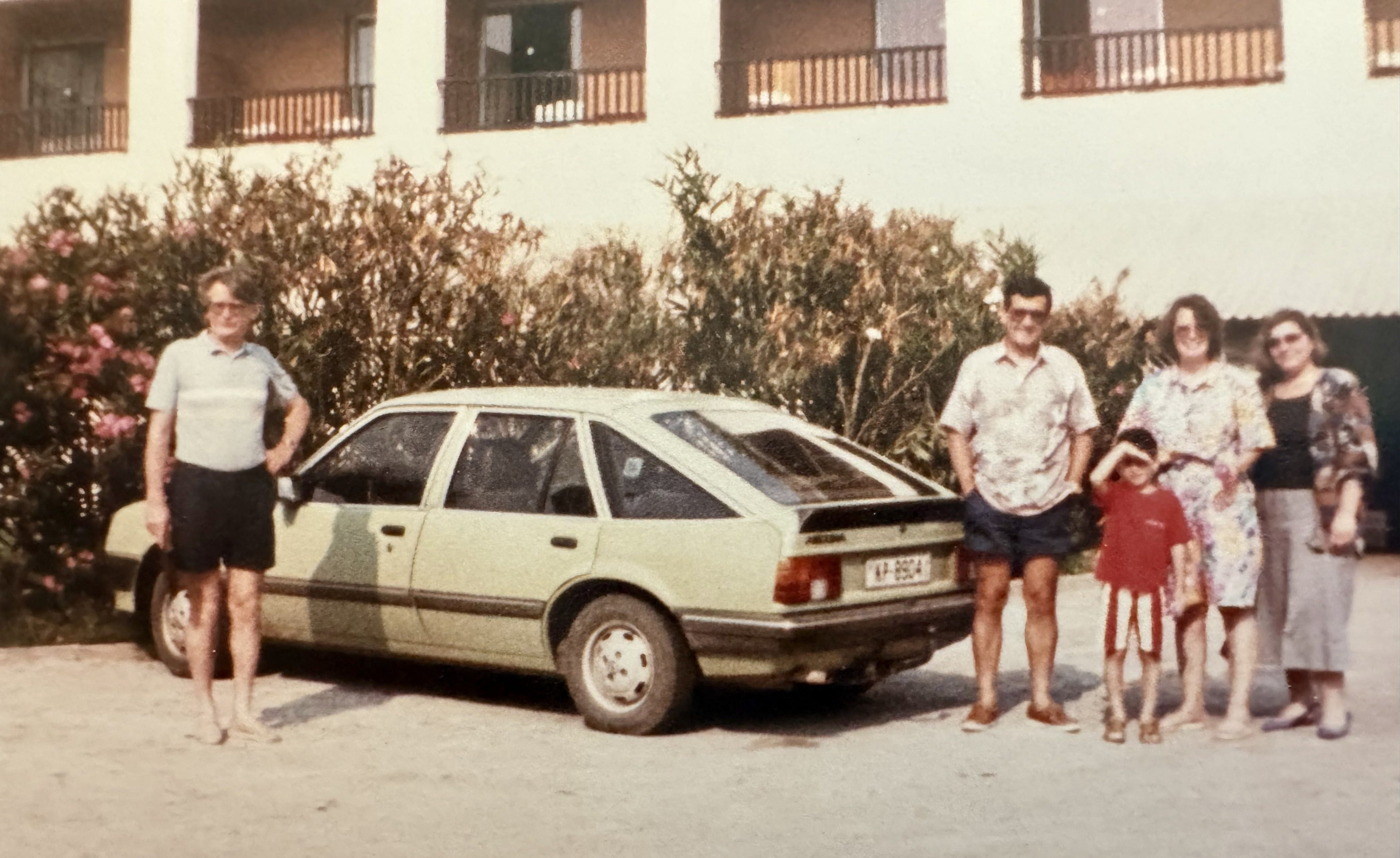
Early on, it was clear that everyone we knew in Serres lived in an apartment, not a house like we had in Denver. I also realized my family there drove motorcycles rather than cars. Only Aunt Litsa and Uncle George had a car, a little olive-green Renault, which we once road-tripped in on an site-seeing adventure. Tiny cars, tiny apartments, little motorcycles—everything in Greece seemed compact, dense, and crowded, but only by comparison to my life in the States. People there seemed happy and comfortable, albeit different in their clothing, daily schedules, and food tastes.
When it came to daily schedules, life was very different in Serres than back home. Every store in town would close for several hours in the afternoon, when housewives served the big midday meal, and families napped afterwards. This big lunch was the highlight of my Serres days: Yaya would make one of her famous dishes, like keftethes (giant meatballs served in a delicious tomato sauce) or yemista (stuffed peppers). Dessert was always fresh fruit, with cherries and watermelon being typical and also my favorites. Yaya spent much of each morning shopping at the daily farmer’s market in town, so everything we ate was as fresh as could be. After lunch, we all retired and slept like babies.
Stores opened up back up for the late-afternoon rush. I remember asking my dad, at a young age, why the stores all seemed to follow the same rules and hours of business. I had also noticed that sometimes the stores had a “sale” or special discounted rate, which they all offered at the same time of the summer. He explained that in Greece, government controlled the businesses and their pricing to a much greater extent than in the United States, where they had freedom to operate in the way that worked best for them. I remember thinking that I liked the American way, and the concept of freedom started to take on new meaning for me.
In the evening, people would venture out to sit in the town square, a central part of every Greek locale, where people congregated to converse, order drinks, smoke cigarettes, and enjoy the cooler part of the day. My brother and I would order our favorite, granitas, frozen strawberry drinks that I’ve never had outside of those youthful trips to Greece. Sometimes I’d get what we called a mocha, basically a coffee ice cream milkshake topped with rich, dense whipped cream. I can still taste it, and feel the joy it brought me, back in those days before calories or dessert eaten at odd hours mattered a whit in my mind.
Later, around nine o’clock, we’d head out for dinner, usually a lighter meal of fresh bread, Greek salad (salate), and mezzes including patates (similar to french fries), kolokythakia (fried zucchini), taramosalata (salted fish roe spread), and tzatziki. Dinner was always al fresco, under a darkening sky and yellow lights and mosquito lamps, and it always featured lively conversation between the server, who might have been the restaurant owner, and my family, who had almost certainly argued beforehand about which establishment to patronize, and whether the owner was a fascist or a communist. The dinner choice was always about much more than food, but the food was certainly important.
In fact, to say food was important in Greece is an absurd understatement. Food in Greece was life; food was fellowship and enjoyment and the product of painstaking selection and effort and freshness. Food there was not processed or “fast” or an afterthought, or consumed thoughtlessly. Food is central to my memories of Greece; the idea of having some warm bougatsa, a Serres specialty, with its sweet custard filling between sheets of flaky phyllo dusted with cinnamon and powdered sugar, fills me with the most intense nostalgic longing of any childhood memory. We always ate it with a glass bottle of chocolate milk on the side; it was goat’s milk, like all the milk in Greece, and while I never had a taste for goat’s milk, drinking it with the bougatsa was heaven.
***
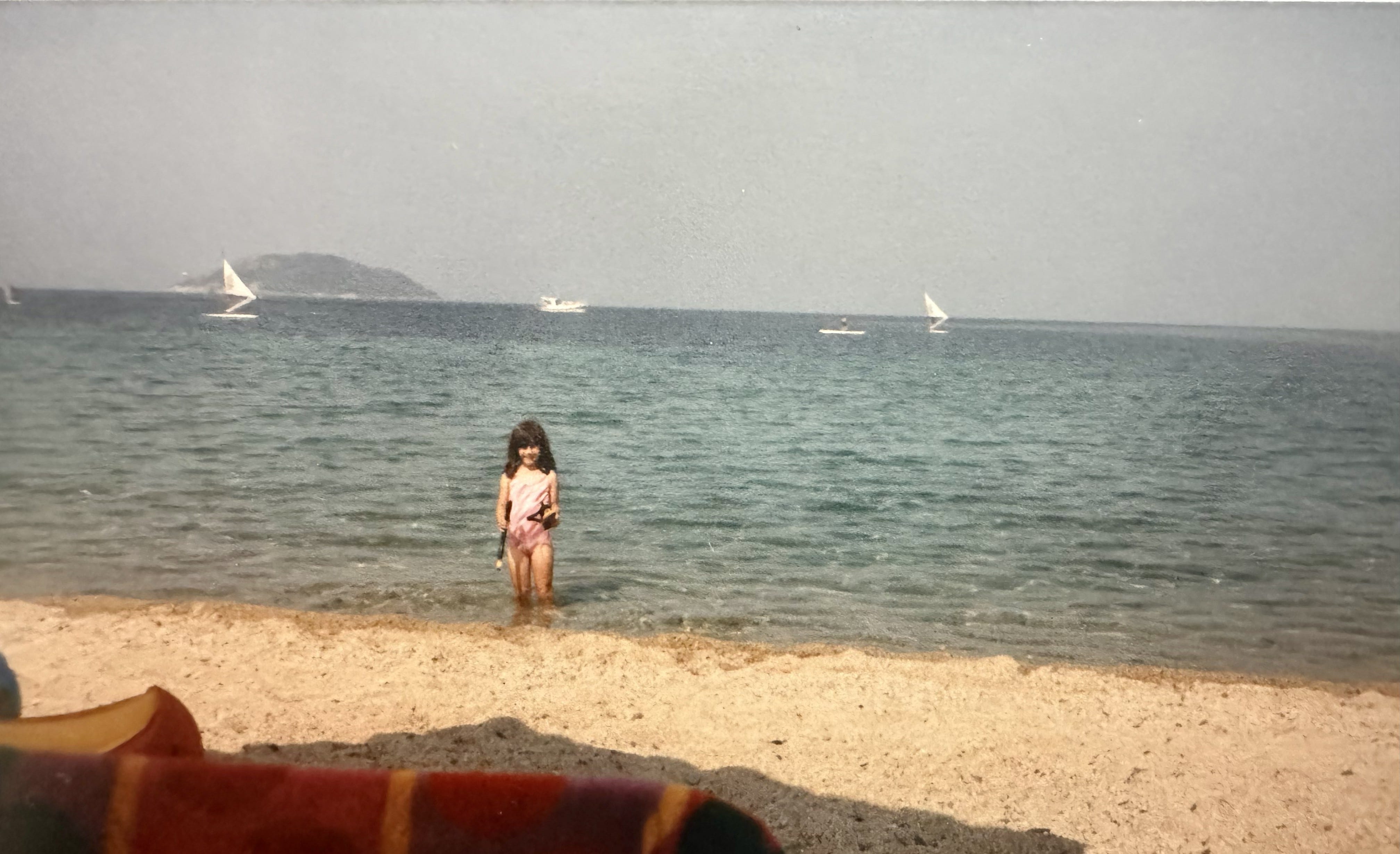
I loved visiting my dad’s other sister, Aunt Rita, in an apartment in Athens, along with Uncle Harry and my cousins there, Nikos and George. The islands were also wonderful, especially since we stayed on islands that were not targeted by most tourists. My brother and I would spend all day on the beach, often surrounded by women wearing only bikini bottoms. The toplessness was so normal that I didn’t think about it; but in hindsight, it’s yet another feature of my travels to Greece that taught me how different things look in different parts of the world. Different wasn’t bad, it was just unfamiliar at first; and that open-minded attitude was a natural result of being immersed in foreign places before having a set opinion about the way life should be.
I’m so grateful now for that lesson, and for gaining the perspective in my formative years that places exist in the world where people have less than we do, and people want less than we do, and people appreciate life in rich and unique ways that look completely different than in our home environments. People spoke different languages, and lived with no air conditioning, and stray dogs lived in the street, and were ingenious in their ways of getting scraps and water and care when it was needed. Everything about life in Greece looked different, but because it became familiar, I loved it in its different-ness.
When we flew back home to Denver each summer, after connecting in Newark or New York, I was always shocked to see our three-car garage in our single-family house with a backyard in a quiet neighborhood. My first bite of a cheeseburger, or American cereal with cow’s milk, would always taste divine, but they were never quite as delicious as my yaya’s keftethes or bougatsa in the Serres square.
***